How do I keep my awning fabric clean? This is common question, but often asked too late in the lifespan of the fabric. We educate our customers at the time of purchase, but its hard to keep up with that stuff after so many years.
The first step in keeping your fabric clean is to choose the right fabric for your awning location. Lets say the wall we are mounting on is facing south, has new brick or wood, and not too many trees or large foliage around it. For this location we could use just about any fabric or color and get great results. On the other hand lets say your mounting location faces north, or has lots of trees, or the building is very old brick with lots of stains. For this location we really want to consider a non woven product, like a vinyl, that will stay dry and resist dirty water sitting on it.
Perhaps you already have fabric awnings that are dirty, or you had to have a fabric type/color to match your brand that you know will get nasty. If that is the case, the first step is to review the fabric manufactures cleaning and treatment instructions. Follow those! Do not power wash or try some wiz-bang fabric cleaner you heard about. Elbow grease is likely required and often hated. Like most outdoor items, keeping them clean early on and from the get-go always maximizes lifespan. Your awnings are no exception, like anything else on the exterior of your home. Service is required at some point.
Spring is here! Get your orders in ASAP.
Ah yes, spring is in the air. Things are getting green and temp is getting warm. What is also happening is that we are getting busy. I dont want your “need it for the summer” project to get delayed! Please contact us if you have something that needs attention. Maybe your awning needs recovered, maybe your restaurant needs a patio cover, maybe your sign customer needs a branded awning to complete their new look. Reach out to us!
Welhener – H.B. Wall services southern MO, AR, KS, and OK.
Kansas City Tent & Awning services the Kansas City area, northern MO, and KS.
Is an awning a sign?
Is an awning a sign? The short answer is no. While awnings can certainly be a surface to print artwork/logos/etc. on, it is not a sign structure. People paint their signage on brick walls or windows too. An awning, more often than not, remains on a building or structure regardless of pylon signs or cabinet signs or illuminated signs. Awnings, generally, become real property once they are affixed to a building or structure or piece of real estate. Are awnings used as part of “branding packages” for businesses? You bet! Hire an awning company to build your awnings. Hire a sign company to build your signs. Ensure things are done properly.
Happy New Year! Are you interested in Fabric Awnings?
Happy New Year! Now is a great time to explore fabric awnings and canopies. Modern outdoor fabrics are amazing. They provide shade, shelter, and allow for unique shapes and designs. Nearly any color or stripe pattern you would want, and warranties of 10yrs plus. Call us to chat with a design professional. If you want metal canopies or metal awnings, we make those too!
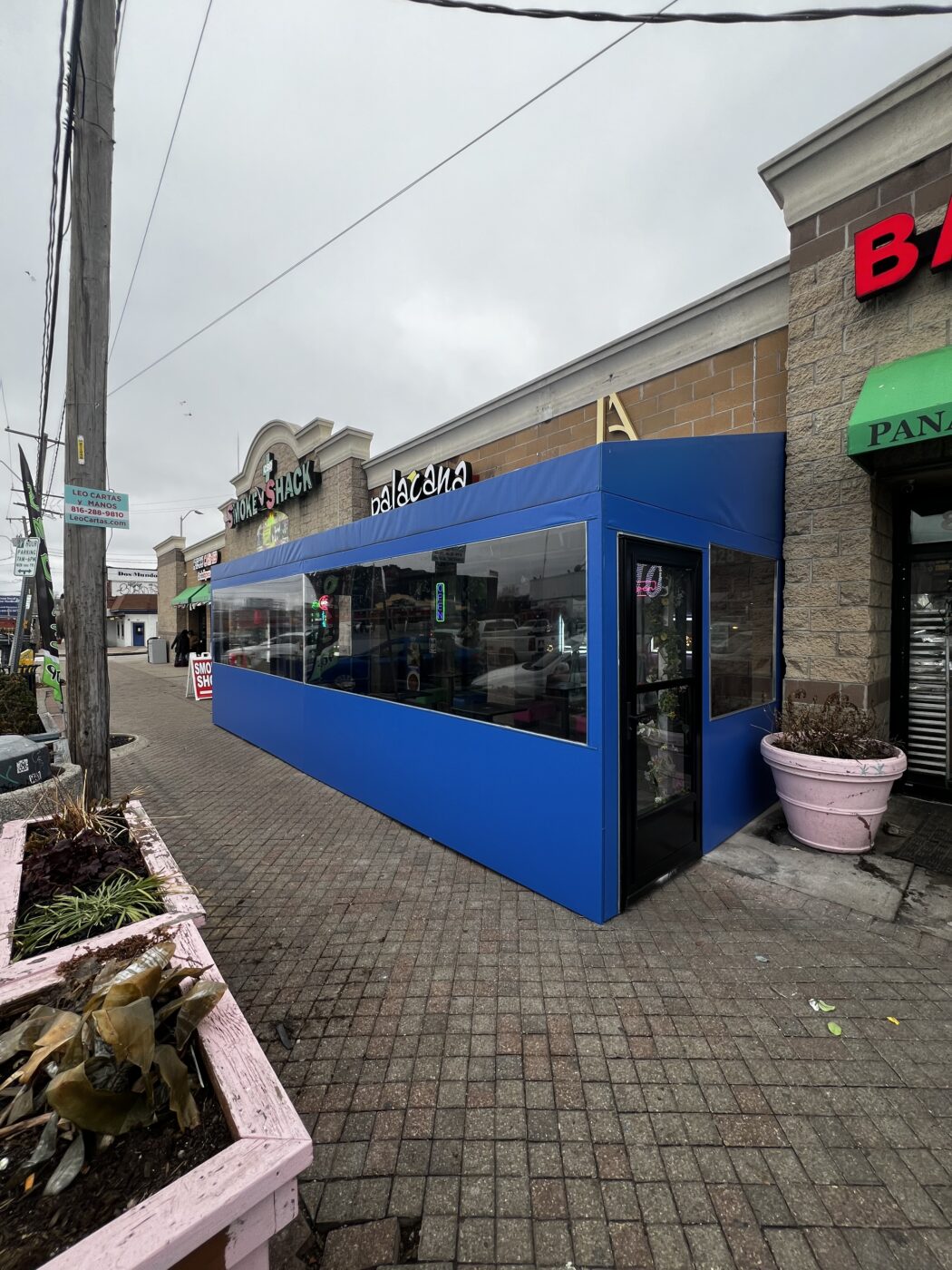
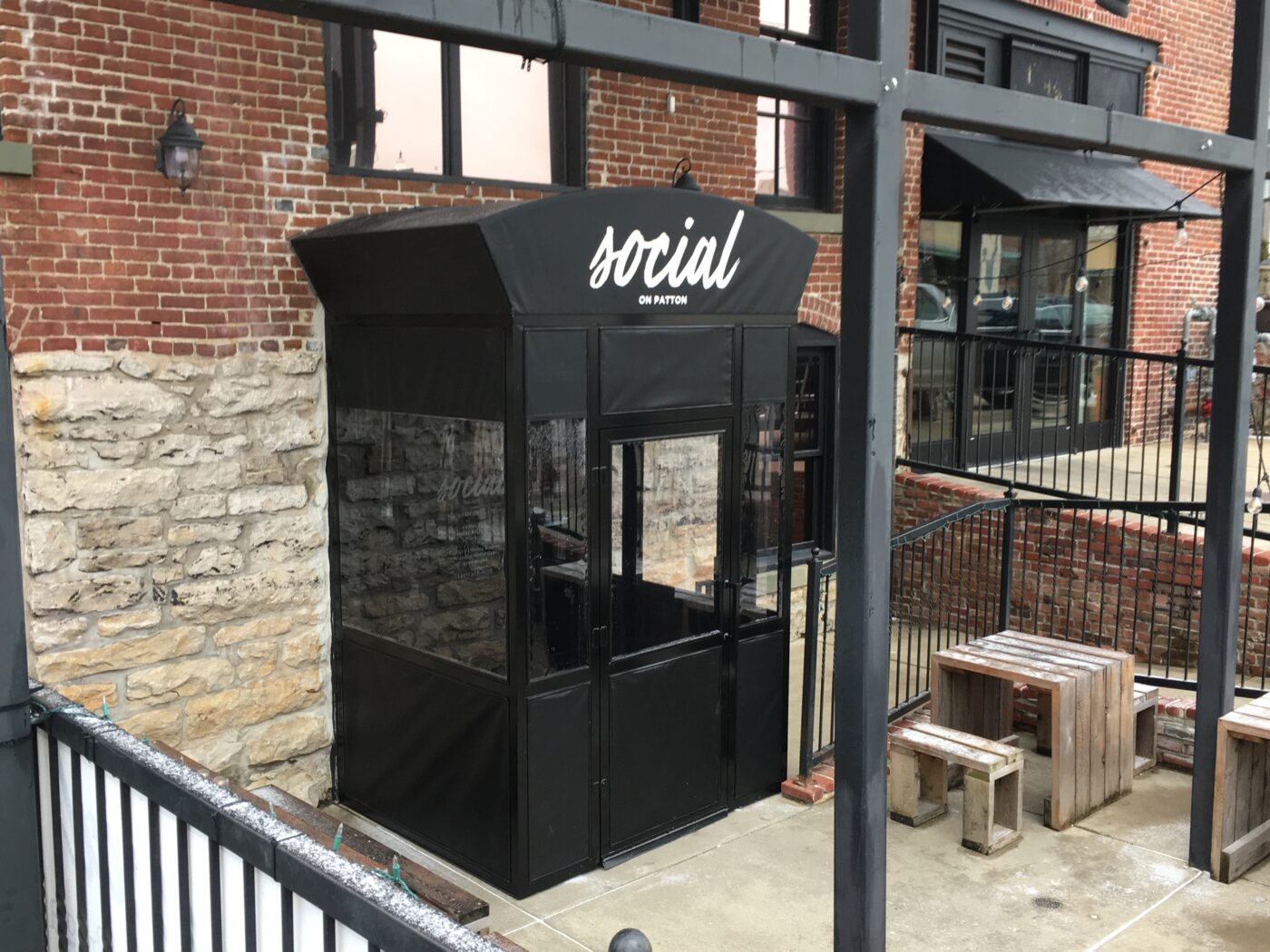
Its winter time! Conserve warmth with a vestibule at your entrance!
Every time a customer opens your door, you can feel the cold air! Make things MUCH better with a vestibule. We can even fabricate under an existing awning! Call today to discuss.
How is fabric attached to an awning frame?
This is a good question and worth some discussion. Depending on how the fabric is attached can have an impact on the ease and cost of the replacement fabric, or if can be repaired, should something happen.
In our region of the USA, quality frames are constructed of aluminum or galvanized steel. They are almost always welded together. Some of the frames have extra bars welded interior that serve as points to “rope” or “lace” the awning covers on. We call this a lace bar frame. These are easy to recover and easy to service, should a cover get damaged. These types of frames usually require a full-service awning or fabric company as they require a number of different skills. Sewing machines, grommets, etc.
Some frames use a unique extrusion of aluminum that has a groove in the middle meant to provide a spot to staple the fabric to the frame. This groove is then covered with a PVC filler to cover the staples. We call this a staple frame. This method was developed so that a fabricator could provide a whole awning without the need to sew anything. This mainly applies to sign companies. The finished product is clean and tidy, but the PVC filler does tend to stand out. Some companies use a hybrid method of sewing and stapling to produce a very clean look. Once fabric is stapled to the frame, it is basically impossible to service it.
Yet another type of frame, one that isn’t welded, is a slip-fit pipe frame. These use a series of fittings and ends to join pipe together. These are usually much older and were made by fabricators that didn’t have the capacity to weld metal. We call these slip fit frames. These style frames are antiquated and are usually hard on the fabric, often many “hot spots” exist that can rub holes in the material. If you have this, it’s worth asking a reputable awning company to make a new more modern frame. These frames do allow for the covers to be removed for service.
The last kind of frame you will typically run across is just plain welded together tube or pipe. Fabric is attached with many screws, or even wrapped around thin strips of metal and then that is screwed to the inside of the frame. This is another common method used by sign companies or others that might not have the capability or time to finish the fabric in more detail. The covers can be removed for service, but they aren’t very clean looking to the discerning eye. When these come to our shop, we often retrofit them with lace bar so that the fabric can go on cleaner and get tensioned correctly.
How to enclose a patio for the winter? Curtains and Walls!
Many property owners have covered outdoor patios that are very useful or even essential to the enjoyment of their home or business. Along comes colder temperatures and suddenly nobody wants to use that patio. What to do? Call Welhener – H.B. Wall Awning or Kansas City Tent & Awning Co. and get some curtains or modular wall panels made to enclose that space! The curtains are just like any other vertical drop curtain that would be secured to the ground, except we can close off the sides with tracks or zippers. Another option are modular wall panels. We fabricate welded aluminum frames and skin them in a performance outdoor fabric. Windows or no windows. These are a little more permanent than a curtain, but are meant to really hold up to the elements. Most of our customers make it a seasonal process. Install the wall panels in the fall, and remove them in the spring. These are great and simple ways to enclose your outdoor room!
Fall is around the corner. What to do with your fabric awnings or canopies?
Fall is around the corner. Seasons are going to change. What should you do with your fabric awnings or canopies? The good news is not much! Fabric quality and technology has come a long way in the past couple decades. Properly constructed awnings and canopies are meant to be up year round. That being said, this is a good time to clean them off and, perhaps, treat them. Consult with your fabric professional on the manufacturers recommended cleaning and treatment procedure. Clean the frame off. Check the wall mounting hardware. All this will go a long ways to keeping your fabric awning looking tip-top for many years to come. If you have a shade sail, it might be time to review if its engineered to hold a snow load. Many are not, and its common to remove them in the off-season in the Midwest.
Have questions? Welhener – H.B. Wall Awning or Kansas City Tent & Awning Co.
How to lower utility costs using awnings and canopies!
Is it possible to lower you utility costs by installing awnings on your home or building? Yes! There are several studies and examples published that conclude properly fabricated and installed awnings over windows, doors, and other identified areas can reduce your utility expense by making it easier to control the climate in your home. And they look darn good too! One just has to look at homes and apartments in many European cites to see fabric in action. Air conditioning is not as prevalent in Europe as it is in the USA, so fabric is used quite often to cut the light and UV entering interior spaces. This makes them cooler and easier to manage. Ask our staff members for help if this is a concern of yours. Enjoy the summer and stay cool.
Cost saving measures for your awning or canopy project.
The economy is not particularly healthy right now. Interest rates are up, the labor market is hurting, and suppliers still face issues getting product to market. All that being said, suppose your awning or canopy project needs to proceed? We, of course, love to hear that…..but let’s discuss simple ways to save some money and still get a functional and aesthetically pleasing structure. Fabric awnings and canopies require more significant shop labor since several skills are involved. If you can pick an awning shape that uses less metal, welds, or welder labor hours you are off to a good start. Same goes for fabric. It takes more time and material to add a free hanging valance or sew the pies of a rounded awning together. Knowing all this, perhaps its best to pick a simple wedge or triangle shaped awning over a dome or bubble. If you wanted a painted or coated awning frame, this would be an opportunity to stick with mill finish metal. Of course consult with your sales estimator and have several conceptual images done to be sure this style still works with your architecture.
Metal canopies and covers usually have a two or three areas that can yield savings. The most expensive option would be an extruded aluminum canopy with tall welded gutter/fascia and extruded decking. Step one might be to reduce the height of the gutter/fascia from, for example, 12″ to 8″. Also, if you have any profiles or extensions built into the fascia for effect, omit that. A step further might be substituting the extruded decking for a roll-formed product. Or perhaps substitute the fancy adjustable over-head support rods for a simple tube. Does this not quite cut it? We can go even further by offering mechanically assembled canopies using all roll formed components or a combination of both. Always consult with your sales estimator so you know what you are getting. I have seen contractors sneak in cheaper systems while advertising them as something they are not.
What are some things to avoid in either scenario? Don’t gamble on cheap fabric. Stick with quality name brand fabric that has a track record of use in your market. On your metal canopy, pay close attention to the colored finish the fabricator applies. While it’s unlikely you will have a structural problem with a metal canopy, nearly all of the problems that pop up down the road are related to poor finish application. Just slapping some paint on the aluminum will simply not cover it. Significant prep is required and quality finishes cost money. But it’s worth it 15-20 yrs. down the road when you are still going strong!
Contact us for more ideas on how to save some money on your next project. Kansas City Tent & Awning Co. OR Welhener – H.B. Wall Awning